
Lessons from Ambazonian History – Fontem Neba

Featured

HOW ELITE COMPETITION AND CO-OPTATION WRECKED THE SOUTHERN CAMEROONS’ QUEST FOR INSTITUTIONAL CHANGE

— Lessons for the Present Generation

Fontem Neba, PhD
(Scholar, Critic & Political and Civil Rights Advocate)

Abstract
The political crisis and armed conflict in the former British Southern Cameroons cannot be understood solely through the events of 2016. Its deeper roots lie partly in the failure of political elites during the democratic opening of the 1990s to consolidate the unity of purpose demonstrated by the All Anglophone Conferences of 1993 and 1994. This essay argues that regional elite competition, political co-optation, and the proliferation of organizations such as SWELA, NOWELA, and NOCUDA weakened the collective pursuit of institutional change. Rather than building durable institutions capable of protecting the common interests of the people, influential politicians increasingly competed for access, appointments, resources, and recognition from the central government. The resulting NW–SW divide weakened collective bargaining and allowed longstanding grievances to fester.

The argument does not suggest that every regional organization was inherently illegitimate or that every individual associated with these organizations shared identical motives. Rather, it examines the political consequences of a process in which regional and personal advancement increasingly competed with the broader collective institutional project. The naming of actors is therefore intentional. It is not intended for public lynching, vendetta, or retrospective punishment, but to establish the historical record and allow future generations to examine the decisions, relationships, and political choices that shaped the course of Southern Cameroons history.

Introduction
The contemporary crisis in the former British Southern Cameroons did not emerge suddenly in 2016. Its roots extend through decades of unresolved constitutional grievances, political marginalization, institutional weakness, elite competition, and the inability of the state to establish a durable political settlement acceptable to the people of the former British territory. The events of 2016 should therefore be understood not simply as the beginning of the crisis but as the dramatic eruption of wounds that had been allowed to fester for decades.
One of the most consequential periods in this history was the political opening of the 1990s. The return of competitive politics created an opportunity for Anglophones to articulate their grievances collectively. The All Anglophone Conference in Buea in 1993, commonly referred to as AAC I, and the second conference in Bamenda in 1994, AAC II, represented an extraordinary moment of cross-regional political mobilization. AAC I brought together representatives from across the Anglophone territory to formulate a common position on constitutional reform, while AAC II sought to carry that process forward after the constitutional reform process had stalled.

North Westerners and South Westerners demonstrated that regional identity did not necessarily have to prevent collective political action. They could retain their distinct regional identities while recognizing that their shared institutional interests required a common political strategy.

The tragedy was that this unity of purpose was not consolidated into a durable institutional structure. Instead, sections of the political elite increasingly pursued regional organizations, personal political advancement, access to the central government, and competition for state resources. SWELA, NOWELA, and NOCUDA became associated with an increasingly regionalized political environment. The problem was not the mere existence of regional organizations. South Westerners and North Westerners had legitimate interests that deserved representation. The problem emerged when regional political competition began to displace the broader institutional project.

The central government also had a profound interest in preventing the emergence of a unified political movement capable of sustaining pressure for constitutional change. The mobilization and political awareness generated by AAC I and AAC II demonstrated the capacity of the population to organize across regional lines. That development could not have been comfortable for a highly centralized regime. It is therefore not surprising that CPDM stalwarts within the Southern Cameroons became important actors in the political response to this mobilization. Contemporary accounts of the period describe attempts by regime-aligned actors to distance regional constituencies from the AAC process and opposition to the consolidation of the movement.

The central argument of this essay is therefore that the institutional opportunity created by AAC I and AAC II was progressively weakened when regional competition, elite ambition, and state co-optation displaced the collective pursuit of structural political reform. What had briefly become a common Southern Cameroons political project increasingly became a competition over who could secure greater access to Yaoundé, government appointments, development resources, and political influence.

This argument does not absolve the Biya regime. The central government possessed vastly greater political power and bears primary responsibility for maintaining the centralized system, resisting meaningful constitutional reform, using co-optation as a political instrument, exploiting political divisions, and ultimately responding to renewed Anglophone grievances with repression. But political power does not remove the responsibility of those who claimed to represent the people. Political elites also possessed agency, and their choices had consequences.

The purpose of identifying individual political actors is not public lynching, vendetta, or retrospective punishment. Political history cannot be adequately understood through an anonymous reference to “the elite.” Identifiable individuals occupied positions of influence, founded or promoted organizations, accepted government appointments, interacted with the regime, and participated in political processes whose consequences affected the population. Those facts should be placed before the historical record so that future generations can examine them honestly.

The Lost Moment of Southern Cameroons Unity
The democratic opening of the early 1990s created an opportunity that had not previously existed in the same form. Competitive politics enabled Anglophone grievances to be articulated publicly, while the emergence of the Social Democratic Front created a powerful political vehicle with particularly strong support in the North West and significant support in the South West.

For many Southern Cameroonians, the political question increasingly moved beyond individual representation within the central government. The issue became the structure of the state itself and whether the historical, legal, educational, and institutional distinctiveness of the former British Southern Cameroons could be protected.

AAC I in Buea in 1993 represented perhaps the clearest expression of this collective consciousness. Its significance was not merely that delegates adopted resolutions. Its deeper significance was that North Westerners and South Westerners demonstrated that they could formulate a common political position despite their regional differences. The Buea Declaration was explicitly concerned with adopting a common Anglophone position on constitutional reform.
The conference therefore created something politically important: a common platform through which institutional grievances could be presented as collective grievances rather than as competing regional demands.

AAC II in Bamenda in 1994 sought to consolidate that achievement. The conference considered the stalled constitutional reform process and the execution of the mandate given to the Standing Committee by AAC I. It subsequently reorganized the institutional structure for pursuing the constitutional agenda.

At this point, the central challenge was no longer simply mobilizing the population. It was building an institution strong enough to maintain collective political action. Such an institution could have accommodated legitimate regional differences while preserving a common negotiating position. South Westerners could have demanded safeguards against North West domination, while North Westerners could have demanded corresponding safeguards against South West domination. The answer to regional insecurity could have been institutional design rather than political fragmentation.

Instead, the emerging unity was progressively weakened. Constitutional reform, federalism, institutional guarantees, and collective political rights were increasingly overtaken by regional competition. What had initially been a difference between two regions within a common political community increasingly became a political cleavage that could be exploited by politicians and the central government alike.

SWELA and the South West Elite
The emergence of the South West Elites Association, SWELA, must be understood within this environment. The principal South Westerners associated with fostering SWELA included David M. Iyok, Abraham T. Enaw, Chief Emmanuel Tabe Egbe, Ephraim Inoni, and Chief Fomenky. Their concerns did not arise from nowhere. Many South Western elites believed that the political ascendancy of the North West, particularly through the growing influence of the SDF, could result in South West interests being subordinated.

Regional organization was therefore understandable. The problem was not the desire of South Westerners to organize. The problem emerged when regional organization became increasingly disconnected from the wider institutional struggle. Instead of asking how South West interests could be constitutionally protected within a collective Southern Cameroonian framework, political competition increasingly centered on who could obtain greater influence within the central state.

David M. Iyok played an important role in mobilizing South West elites around the creation of SWELA. Chief Emmanuel Tabi Egbe provided an important social and institutional base for the organization’s early activities, while Abraham T. Enaw and other prominent professionals participated in the effort. Ephraim Inoni was also associated with the mobilization of the South West elite network.

The subsequent political trajectories of several actors illustrate how regional elite organizations became intertwined with the state. Peter Agbor Tabi became Minister of Higher Education in 1994 after an earlier career in academia and administration. Ephraim Inoni, who was associated with SWELA, occupied senior governmental positions, including Secretary of State for Finance, before becoming Deputy Secretary-General at the Presidency and eventually Prime Minister in 2004. John Ebong Ngolle also occupied important administrative and governmental positions. Caven Nnoko Mbele and other South West figures became part of the broader political establishment, while traditional authorities such as Samuel Endeley and Victor Mukete possessed considerable political influence.

These careers do not by themselves establish a single motive among all the actors involved. Their significance lies in demonstrating the mechanism through which the central government could incorporate influential regional elites. Political inclusion occurred at the level of individuals while the institutional grievances of the population remained unresolved. A region could therefore gain ministers, senior administrators, and access to the Presidency without gaining enforceable constitutional guarantees.

Peter Agbor Tabi’s career is particularly illustrative because his government position placed him at the intersection of regional institutional interests and central state authority. Ephraim Inoni’s trajectory is equally significant. His rise from involvement in elite mobilization to the highest levels of government demonstrated that a Southern Cameroonian politician could achieve considerable personal political advancement without the fundamental constitutional question being resolved.

The distinction is important: representation in government could produce visibility and individual influence without necessarily producing institutional empowerment for the population.

NOWELA, NOCUDA, and the North West Political Response
The North West followed a comparable trajectory and fell in the SWELA trap. NOWELA, the North West Elites Association, emerged as a regional counterpart within the broader process of elite organization. Its development reflected legitimate concerns among North West elites about political representation, regional influence, and the changing balance between the two Anglophone regions.

Again, regional organization itself was not inherently destructive. The difficulty was that regional organizations developed at a time when the collective Anglophone political project remained fragile. Rather than strengthening a common institutional structure capable of accommodating regional interests, competing organizations increasingly became instruments through which each region sought to secure its own position.

NOCUDA was equally significant in the fragmentation of the collective project. Its intervention in the period surrounding AAC I and AAC II is important because it occurred at precisely the moment when Anglophone unity was being constructed. The political intervention associated with NOCUDA sought to dissociate the North West from the Anglophone Conference and portray the conference as essentially a South West initiative. Such activity contributed to the political environment in which AAC II faced opposition.

The broader political context is important. AAC I had explicitly presented itself as a rejection of the North West/South West dichotomy and called for Anglophones to resist attempts to divide them. Beads of Memory The emergence of regional elite organizations in opposition to that collective political direction therefore had consequences beyond ordinary elite association.

Simon Achidi Achu became the most visible symbol of North West access to the central state when he became Prime Minister in 1992. His appointment was historically significant and demonstrated that an Anglophone, and specifically a North Westerner, could occupy one of the highest political offices in Cameroon. Yet the appointment also reinforced the logic of elite representation as a substitute for institutional reform.
The broader North West political network included senior officials such as Peter Abety, John Niba Ngu, Francis Nkwain, and Samuel Ngeh Tamfu, among others through whom the regime could demonstrate inclusion. Their individual political careers varied, and they should not all be treated as having identical ideological positions. Their significance lies in the wider political structure: the regime possessed a sufficiently deep pool of Anglophone elites from which it could recruit ministers, governors, diplomats, administrators, and other officials.
The result was a political system in which the President could answer a collective demand for institutional recognition by pointing to individuals appointed to important positions. The implicit message was that Anglophones were not excluded because Anglophones occupied high office.

But representation at the level of individuals was not equivalent to institutional protection for the population. A community could have ministers and still lack meaningful constitutional guarantees. It could have a Prime Minister and still have no effective mechanism for determining the distribution of political authority. It could have governors and senior administrators and still remain dependent upon presidential discretion.

The importance of this episode is not that NOCUDA alone destroyed Anglophone unity. The fragmentation was the product of a wider political process involving regional competition, regime strategy, elite ambitions, and institutional weakness. Its significance is that it demonstrated how quickly a common political project could be reframed as a regional contest.

When Peter Mafany Musonge, a South Westerner, succeeded Achidi Achu as Prime Minister in 1996, the regional balance shifted again. From a regional political perspective, this could be interpreted as a South West victory. But from the perspective of institutional change, little had fundamentally changed. The occupant of the office had changed; the constitutional structure remained.

This alternating pattern illustrated the fundamental weakness of elite politics. North Westerners could celebrate a North Westerner in the Prime Minister’s office. South Westerners could celebrate the subsequent appointment of a South Westerner. But ordinary citizens continued to depend upon presidential appointments rather than enforceable institutional guarantees. Their children could not accede to their dream positions without the intercession of these politicians turned gatekeepers. So, the common people remained marginalized, unemployed, and deprived while the politicians fed fat.

Co-optation and the Politics of Access
The Biya regime proved highly effective at managing political dissent through a combination of repression, patronage, appointments, and co-optation. Co-optation did not necessarily require every politician to become an enthusiastic supporter of the regime. It worked by creating incentives for influential individuals to participate in the existing political system and by making personal access to the Presidency more politically valuable than collective bargaining.

The system was particularly effective because it could recognize Southern Cameroonian individuals while refusing to recognize the full institutional claims of the Southern Cameroons population. A Prime Minister could be presented as evidence of national inclusion. A minister could demonstrate regional representation. A governor could demonstrate administrative participation. A senior official at the Presidency could demonstrate that Southern Cameroonians had access to the highest circles of government.

But elite representation is not the same as institutional empowerment. A community may have ministers and governors and still lack effective constitutional protection. It may have senior officials and still have no meaningful mechanism through which citizens can hold government accountable. It may have powerful politicians and still depend upon the goodwill of those politicians to obtain public services.

This distinction explains why elite competition was so damaging. Politicians increasingly competed for access to the very state whose institutional structure the population wanted changed. Once personal access became politically valuable, collective bargaining became more difficult. A unified Anglophone institution could demand structural reform. Competing elites could instead negotiate separately for appointments, development projects, influence, and recognition.

The regime consequently did not need to defeat every Southern Cameroonian political leader. It needed only to make individual political advancement sufficiently attractive to weaken collective action.

The Consequences for Ordinary People
The consequences of this political fragmentation were not merely abstract. Ordinary citizens experienced the effects through weakened institutions, unequal development, declining trust, and the absence of durable mechanisms for addressing longstanding grievances. Regional associations could mobilize scholarships, development projects, cultural programmes, and assistance to communities. These achievements should not be dismissed. The organizations could and did provide benefits to individuals.

Yet there is a fundamental distinction between benefits delivered through patronage and rights protected by institutions. A politician who obtains a road for a community through personal access may help that community, but the arrangement does not guarantee that the next community will receive similar treatment, nor that the road will be maintained after the politician leaves power.

A scholarship obtained through an elite network assists the beneficiary who receives it but can also reinforce dependence upon political access. A ministerial appointment may give a region visibility, but it does not provide constitutional protection. The common man was therefore encouraged to look toward the politician who could “take the problem to Yaoundé” rather than toward institutions through which citizens could demand that the problem be addressed as a matter of right. Such an arrangement might produce an individual road, scholarship, appointment, or government intervention, but it did not create equal opportunities for all or durable institutional guarantees.

Viewed specifically through the question of collective institutional change, the political effect of SWELA, NOWELA, and NOCUDA was therefore NEGATIVE, notwithstanding whatever developmental or representational benefits they may have provided.

The Emergence of the NW–SW Divide
The NW–SW divide did not emerge simply because North Westerners and South Westerners possessed different identities. Those differences had existed long before the 1990s without preventing collective Anglophone political mobilization.

The divide became politically consequential when regional differences were increasingly transformed into competing political constituencies. The population was gradually encouraged to view political success through a regional lens. Which region had more ministers? Which region controlled more administrative positions? Which region had greater influence in the Presidency? Which region benefited more from state resources?

These questions increasingly displaced the larger question: What institutions should protect all of us?
This was one of the most consequential effects of elite competition. AAC I and AAC II had demonstrated that the two regions could act together. Regional political competition demonstrated that they could also be separated.

The consequences continued long after the original political actors had moved into different positions or even left the stage. Distrust accumulated. Historical grievances were reinterpreted through regional narratives. Political competition acquired a social dimension, making it increasingly difficult to restore the kind of common institutional purpose that had characterized the AAC period. |

By the time teachers, lawyers, students, civil society organizations, and ordinary citizens returned to the streets in 2016, the institutional capacity that might have enabled a peaceful collective response had been greatly weakened. The grievances had not disappeared. They had accumulated beneath the surface.

The Cost of Losing the AAC Opportunity
It cannot be established with certainty that a different political course in the 1990s would have prevented the armed conflict that emerged decades later. The Biya regime possessed enormous political power and could have rejected federalism or other reforms even in the face of a united Southern Cameroons movement. Nevertheless, there are strong grounds for arguing that the political trajectory could have been different.
AAC I and AAC II generated an unusual level of political mobilization and awareness. They brought North Westerners and South Westerners together around common constitutional grievances and demonstrated that the population could act collectively across regional boundaries. This development inevitably alarmed a regime committed to preserving the centralized order. It is therefore not surprising that the ruling CPDM deployed its stalwarts from within the Southern Cameroons to weaken the unity created by the AAC, encourage regional divisions, and ultimately rewarded them with co-optation or access to power.

The political logic was straightforward: a unified movement capable of negotiating collectively posed a greater institutional challenge than competing regional elites negotiating separately with Yaoundé. As the collective movement weakened, individual political access became more valuable, while institutional guarantees remained elusive. Had AAC I and AAC II been consolidated into a transparent, representative, and accountable movement, it could have preserved collective bargaining, managed NW–SW differences, and prevented government appointments from becoming substitutes for constitutional reform.

The counterfactual argument is not that unity would have guaranteed peace. It is that its preservation could have strengthened peaceful political pressure and improved the prospects for a negotiated constitutional settlement. That was the historic opportunity lost.

The Moral and Philosophical Dimension
At its deepest level, this history concerns the moral obligations of political leadership.
Political authority is a form of stewardship. Leaders who claim to represent a people inherit its political capital, aspirations, trust, and collective struggles. That capital belongs to the people, not to individual politicians.
The central question is therefore whether political actors use collective resources to build institutions that endure beyond their tenure or convert them into personal influence, access, and temporary political advantage.
This distinction is particularly important where access to state resources depends upon personal relationships. A politician may secure a road, scholarship, appointment, or government intervention and thereby provide an immediate benefit. But such patronage does not create durable political rights. The stronger measure of leadership is what institutions remain after the politician leaves office.

The naming of political actors in this essay is therefore deliberate. It is not an invitation to public lynching, vendetta, or retrospective punishment. Political history requires identifiable actors, decisions, organizations, and relationships to be examined openly. The evidence should establish the historical record; the reader can draw his or her own conclusions.

Ultimately, the issue is one of collective responsibility and intergenerational stewardship: whether political leaders leave behind stronger institutions and greater political freedom, or weakened institutions and continued dependence on personal access.

Lessons for the present generation
The history of SWELA, NOWELA, and NOCUDA reveals a painful truth: a people may possess a powerful common aspiration and still lose it when their political elites place personal ambition, regional rivalry, self-seeking opportunism and access to power above institution-building. AAC I and AAC II demonstrated the possibility of Anglophone unity; what followed demonstrated how easily that unity could be fractured by elite competition and political co-optation. The Biya regime bears primary responsibility for preserving a centralized system, exploiting divisions, and leaving fundamental grievances unresolved. Yet political elites cannot escape responsibility for failing to protect the collective political capital entrusted to them.

The lesson for the next generation must therefore be uncompromising. Never again should political office be mistaken for political liberation, patronage for rights, or regional representation for institutional protection. No minister, prime minister, governor, or influential politician should become a substitute for institutions that belong to the people.

Regional identities must be respected, but never weaponized against a common purpose. Any future collective project must be built on transparency, accountability, equity, equality, and institutional safeguards capable of surviving individual ambitions. History has delivered its warning. The next generation must decide whether to inherit the politics of division or build institutions strong enough to transcend it. The true measure of leadership is not the power one acquires, but the institutions one leaves behind.

Gridlock on an open road in La République du Cameroun as VP still awaited

FeaturedAmbazonian Flag

La République du Cameroun has a system in place to deal with the imminent inevitable transition. Well, not a system, a “law” or a legal device, at best, and a barely legal legal device! Could that be the reason why that device is still not being used and where did the clever idea for it come from. As La République du Cameroun remains firmly locked into an ever-decreasing circle, Ambazonia News wonders …

The advent of the post-Biya reality is pressing on La République du Cameroun. Logic would dictate that the Vice-Presidency would have been filled by now, by the obvious person for whom “Mr Biya”, or more realistically his minions of the RDPC, would have gone to the trouble of getting out-of-mandate ex-MPs to approve the creation of the VP post with the privilege of inheriting “his” hard-stolen term in office without having to earn it, has not been invested. That even though Mr Biya could/may soon be unable to lift a pen or raise his voice to execute that anointment. Why the delay?

Maybe Mr Biya has become aware that his Western mentors are not going to bring their approval to the charade. Mr. Macron may have made it known that he would not risk travelling to Yaounde to stand beside young Frank or whoever the minions hoped could provide “stability and continuity”. Much as the French would desperately want to maintain their vanishing presence in Africa, even they must surely have woken up to the reality that Africans no longer see his presence and “blessing” at an improvised illegitimate “transition” as a reason to bow to it.

It is also possible that the “governants” as the kleptocrats like to call themselves, have finally exposed their impotence in Ambazonia. After ten years of French-like genocide they have only managed to prove to Ambazonians that they have no honour or fidelity to their flag. They have killed toddlers on their way to school, massacred whole villages with children and pregnant women, arrested and “neutralized” young Ambazonians just because they were “suspected separatists”, and only proved they are the most vocal in demonstration the hollowness and utter delusion of “One Cameroun”. At once chanting it while actively proving the complete contrary!

Then there is the “delicate imbalance” within the RDPC where all sectors and regions would be questioning why it is not their turn at the chance of the high chair. Is it fair for the South to get the chair again ahead of the East?, the North?, The West? The Centre?, The Carpet bagger? The Ambazonians? Mr. Biya is no more able to fix it than “he” was before “he” ordered, more like bribed, the out-of-mandate hungry MPs to rubber-stamp his decision in a week – unlike other decisions which drag for decades. The while process only highlighted the illegitimacy and the unfair dominance of the executive over the legislature – ironically grating for a “legalist”, as certain politologs would call him! Just like the “army” proving in an Ambazonia that “One Cameroun” is a “No”, the RDPC proved in “parliament” that “Democracy and legitimacy/legality” are a “No” in La République du Cameroun. In trying to fix, the RDPC only breaks!

The unlikely kite of an Ambazonian VP was actually flown when rumours/speculation/manipulation had it that the Ambazonian President would be released and offered the post to solve, what they still call the “anglophone crisis”. As appealing as that would be as a solution, it would founder on its own lack of logic and incredibility! Why spend so much effort on genocide and then go that far in “solving” it alternatively. Why pass up the more credible opportunities of the Swiss Process and the Canadian pre-talks only to go for what would still, while apparently “internal”, a more costly solution in credibility and angst? That made no sense be was floated as a scenario. Why? Because people in La République are dumbfounded by the ineptitude of their very own RDPC and willing to reach for any kind of rationality somewhere within the kleptocracy.

RDPC politologs are also finding themselves on a sticky wicket to argue that young Frank should have an equal opportunity to be appointed VP as any other citizen! Not needed except, like all the RDPC’s solutions, it highlights the problem they have created to try to solve. In this paradox, yes he should have the same right as any other citizen (even though he does not given that “his father” is not considering another citizens) with or without equal opportunities! Even if he were, it would still be incongruous in a democratic state to use such undemocratic means to give one express person the right to impose, yes “impose” even though it is “not an imposition” as it is now legal! To maintain the balance and fairness the VP would need to be from anywhere else than the President, after all Mr Biya is most celebrated for engineering stability by distributing privileges.

The last explanation? Mr. Biya does not want to give up “his mandate” by nominating a VP, thereby announcing his imminent exit. He will wait to the “end” and hope that everyone believes he appointed a VP, which would be hardly legal given that that VP would have to go straight to President without “serving” a single day as VP! A ruse, if ever one were devised! Mandates belong to the “people”, who give them, or even have them seized, and should revert when the mandated is “indisposed”. At least the RDPC should have to steal it afresh for legality’s sake.

Who said any of this was about legality? They would like to say it, but that means they are highlighting the very illegality, or at least the illegitimacy of it! Meanwhile the clock is running down – and there will not be any additional time.

Adieux Cameroun! Welcome Ambazonia!

La République du Cameroun: le renouveau témoigne de son âge

FeaturedAmbazonian Flag

In La République du Cameroun, it is over a month since the RDPC “won” – well, that is, was declared winners of the presidential poll, by Mr Biya;s hand-picked Constitutional Council.

When Mr Biya first came in 1982, his catch phrase was “renouvea”, the French for renewal. Now ailing and decided not “new”, he is fighting the people of La République du Cameroun against “renouveau”. How ironic!

This week, in more “evidence”, for want of a better word, of the RDPC’s fight against renewal in La République du Cameroun, Mr Biya’s government has deployed military units to encircle the home of Prof Maurice Kamto, he who was pre-defeated in the infamous and embarrassing, president poll, to stop his party from … meeting. Meanwhile, propagandists of Mr Biya’s RPDC have published another precious letter of congratulations on social media to show that an important foreign country state has shown implied support for the presidential poll!

At this point, Mr Biya’s RDPC seems so desperate that they have not deemed it necessary to “renew” the inept and corrupt government which had already largely survived Mr Biya’s 2018 poll rig. The question asks itself: what is Mr Biya planning to do other than fight the citizens he promised peace to in the run up to the October 12th 2025 poll rig? No movement to start using the “mandate” to govern yet but he has resorted to calling out the armed forces to stand against “the people”!

Since the poll, some of the validator “candidates” have broken their cover and started “offering to take part in a government of national unity”. In 2018, they had carried out their task by making noises and complaints about the electoral system prior to the poll, and then quickly folding and congratulating Mr Biya after the poll rig. Even back in 2018, it was clear Libii, Osih or even Muna were not contenders but were only in for the cheques. This year, they again fulfilled the same role but, having banked the cheques, they are making overtures and angling to join the gravy train that is Mr Biya’s “government”. Poor La République du Cameroun!

It is such a good time to call oneself Ambazonian! Imagine having to admit to being from La République du Cameroun. It is time for Ambazonians to return to Complimentary Commitment to actualize their freedom. All the Ambazonians out of harms way away from ground zero should do their duty and support the brave Ambazonian Restoration Forces Plus. They can do so by getting back to their choice of Independentist Entity.

Many of the major independentist groups are signatories of the Leadership Pact, working collaboratively under the umbrella of the [Ambazonian] Consultative Commission. Ambazonia News urges Ambazonians to press their chosen groups to work more actively to remove this final humiliation of of being occupied by a lame duck RDPC which is unable even to “enjoy” its stolen election victory in their own place.

Corruption in Cameroon: The Biya Administration Exposed

FeaturedAmbazonian Flag

Mr Biya “did so swear” again. At Ambazonia News we would gladly swear that all the fingers on his obscured hand were crossed, just as they were the previous times. Legend has it that if one swears intending to dupe or lie, or not meaning it, they avert the curse if they have their fingers crossed. Ergo, Mr Biya’s fingers must have been crossed.

In his previous term, he failed to protect the any aspect of the country’s interests, instead spending vast periods of time wasting the nations resources, he could have deployed to create health facilities for the benefit of the nation, on lavish personal provision, admittedly for his health but hardly for the benefit of the nation. On the subject of health facilities, have failed to cater for the numerous women who fell victim to a corrupt and inefficient decaying health “infrastructure”.

It is common knowledge that many women “lost” their babies delivered in the system, sometimes said to have died during birth, sometimes literally “misplaced”, as in stolen from the institutions. Some were detained after “treatment”, or, more accurately, a “stay” in “hospital”, until they could cough up the fees. He did not try to provide the basic health care, a president should, who has sworn without crossed fingers.

In La République du Cameroun, under Mr Biya’s watch, it has also become normal to openly demand bribes from travelers on numerous check-points. These check points have been constant, including during all the peaceful periods, and are openly acknowledged and understood to be a racket run by the police hierarchy to supplement their pay. That means business is stifled on a daily basis. The hard-working citizens have to factor in these extra random costs which render business completely unpredictable and anything from less rewarding to pointless. When it comes to business in LRC, any operator must first become corrupt and metaphorically willing to swim in a cesspool.

As for the young who are supposed to be beneficiaries, according to Mr Biya’s latest promise, gaining admission into any public educational institution is paid for, for the lucky. The “concours” system is known to be a racket for ministers to collect huge sums to designate the “pass list” for places such as ENAM, which, unsurprisingly, produces corrupt administrators, who borrow colossal amounts to gain access to “training” and then immediately, on graduation, try to recoup their investment. Even secondary schools generally operate on a “Tchoko” system where spaces are sold.

The ENAM graduates all rely on Mr Biya for appointments.

Mr Biya’s fingers must have been crossed in 2018 as he hardly appeared during his expiring term, instead wandering the globe usually oblivious of where he was and what he was there to do and wasting resources he could have deployed to keep some of his promises – except he had crossed fingers.

Even forgetting that he did not formally declare that he was running for the latest poll, it is still odd that he did not turn up to any campaign during the process. He also left the country during the campaign to get medical treatment abroad, highlighting hi own failure and negligence to provide health care he could rely on. This fact would be political death in any other democracy, and was for Mr Biya, except it did not matter because the poll was utterly unfair.

ELECAM, the election commission is his commission of his party members. The aforementioned administrators from ENAM are all appointed by him and they are in charge of the logistics of the poll. If one could ignore the unfairness of ELECAM and the ENAM administrators, one still has to reckon with the Constitutional Council, a group of retired judges, all members of Mr Biya’s party and appointed by him!

The upshot of all these is that Mr Biya, who has failed seven times in providing for his citizens, did not formally enter the race nor campaign AND was running genocidal conflicts in parts of the country, and therefore should not have been able to stand is a very unlikely, and unbelievable “winner”. “Unbelievable” as in “lacking credibility”. There is no credibility in any idea that anyone with the flaws Mr Biya “brought” into the campaign could have won, never mind that he did not even campaign!

Unsurprisingly, the diplomatic missions in La République du Cameroun were loath to be seen at his investiture and nor did they send him any messages of congratulations on the election. The US sent a letter to congratulate Mr Biya on his investiture. The electoral charade may as well never have happened!

Mr Biya is not the only one to blame. On reflection he could be argued to be blame-free of the whole system. Clearly he did not personally “tamper” with the ballots in “North West” or “South West” or anywhere else.

The system in La République du Cameroun is as untenable, not to say intolerable, as the French system around the 1780s. As the best student of the French Mr Biya must have ways of avoiding the fate of the French system all those centuries ago.

Whether the people of of La République du Cameroun “object” or not, Mr Biya will find that time objects more and more as he tries to navigate another term of high instructions.

Ambazonia’s route

Ambazonia had a small hope of a slightly more genuine negotiated exit from the Ambazonian Liberation Struggle thanks to Mr Tchiroma’s manifesto “commitments”, even if they fell well short. As short as they fell, they went much further, and infact, out of sight of any ideas Mr Biya has postulated. It is well known that, regardless of any double-talk, Mr Biya literally offers no solution as he hopes to defeat Ambazonia’s quest for freedom. Equally, it was always virtually certain, from experience and thr RDPC’s “efforts” in the campaign that they would resort to their back-stops in the machinery and so Mr Tchiroma’s offer was only really useful for international partners to be aware that there could be an alternative solution to Mr Biya’s and the RDPC.

The reality now is as it was before the charade was entered in La République du Cameroun; we have to win our freedom. In a way, a clear and unique goal is no bad thing and the charade has blown many entities’ cover as well, further distilling the Ambazonian camp to the truest independentists. The truest independentists with experience and stronger arguments to present to any international partners of good will.

The truest independentists with clear sight of the fifth columnist who defied shame and indignity to operate the RDPC’s fraud machines purportedly from Ambazonian soil. Their day is coming.

Ambazonia’s day is imminent.

The watch words are “Daring Move”, “Action and Accountability”, “Complimentary Commitment” and “Building Bridges”.

The Most High God is the Watchman of Ambazonia

Ambazonia’s Response to Biya’s Re-election: A Fragile Future

FeaturedAmbazonian Flag

As expected, the hand-picked and dozy Constitutional Council announced Mr Biya as the winner of the 12th October 2025 presidential poll in La République du Cameroun. The decision from a feeble would-be grandiose presentation had already been trailed and rejected by the already-wised-up electorate. For the week before the announcement, while Biyta’s proxies tried to “bring back” Tchiroma in “secret” negotiations in France, there was a fevered atmosphere of “not this time” as more and more PV’s showed a clear victory for Tchiroma, Mr Biya’s camp dismissing the evidence as “raw data”.

“Raw data” would be laughable in other contexts. In La République du Cameroun sounded as ominous as “guarantor of peace, youth interest, women’s interests”, the ideas which were postulated in Mr Biya’s “ambitions” for an 8th term! Those Ambitions, with hindsight could be seen as threats, suggesting Mr was threatening to unleash his yet-more-misnamed “forces of law and order” on the “beneficiaries” of those electoral “ambitions”. The “ambitions” would not tally with a long “serving” president who is running a civil war against women, children and youths; has maintained a system of “only-the-old”, whose only objective is to survive. During the “campaign” , in which he did not campaign or even present his own candidature, he had to go to Europe for medical care, having failed to achieve in four decades, the simple ambition of creating one health facility to which he would entrust he care. In his last term and prior, women have lost babies in hospitals, many patients have been detained for bills … Even his proxies would not swallow his “ambitions”. In context, “raw data” – not yet cooked, not yet “processed”, not yet falsified.

“The people” have rejected Mr Biya’s “re-election” with [sporadic] marches of protest which have left Mr Biya and his proxies seeking ways to “exercise authority”, to the extent that they have gone to ridiculously petty lengths. One of the “targets” is reported to be Mr Biya’s self-proclaimed best supporter being stopped from entering Garoua and turned around to return to Yaounde. Yes, because “Le Cameroun c’est le Cameroun”, Pr Messaga Nyamding was prevented, on arrival, from leaving Garoua Airport and sent back on the same aircraft.

This suggests Mr Biya’s cronies were hopping to be breaking more limbs by now. Instead, they are left waiting. Ambazonia News does understand there have been several deaths. The atmosphere, though is still expectant.

Mr Biya’s regime is in place still – just. It is very much devoid of any power. It is not in power. Even the traditional “letter of congratulations” has not arrived from mentor France!

Imagine being in office but not in power, looking for ways to “show” or exercise power.

By contrast, there are more voices openly challenging the regime but cleverly not presenting the regime with the fodder they would dearly love to go at! The Camerounese have their voices back and have finally caught up with the idea that they must run their own lives and livelihoods. Ambazonia News will keep tabs on the various ways they device to nudge Mr Biya’s regime aside.

This story is not yet told! The regime is going to die of idleness and self doubt at this rate.

What should Ambazonians do?

Nothing new. There was never going to be a speedy solution whatever the result in La République du Cameroun’s poll. The fragility of Biya’s regime does present an opening.

Ambazonia does not to clean up the slur that Mr Biya “received 86%” of votes in Northern Ambazonia. Though this clearly fictional, the authors still need to account for the damage to the memory of all the ARF, women and children who have fallen to La République du Cameroun’s genocide.

From Ambazonia’s perspective Mr Biya’s “victory” has the one positive of keeping our number of choices at one. We still need to get our country back and one more year of experience only helps.

We need to stride out now more focused on what we need to do and do it with, for want of a better phrase, sang froid, deliberately aiming our efforts for the most impact and effectiveness in uprooting the illegal and forceful occupier.

Tchiroma “Wins” but … Biya could still be announced.

FeaturedAmbazonian Flag

“Le Cameroun c’est le Cameroun” is a summary of an electoral process which, in any other corner of the world would not be under discussion, never mind “in the balance”.

But, as “Le Cameroun c’est le Cameroun”, Tchiroma’s victory, like those of Fru Ndi in 1992 and of Kamto in 2018, is still in “doubt” despite every “indication” and reasonable observation showing it as the inevitable outcome.

Mr Biya did not campaign, anymore than he did in 2018 when he “won” through control of the football, the goal posts, the referee, the match delegate … and a back stop of the “homologation committee”.  “What is a homologation committee?”, some might ask. In Cameroun football, there is a committee which can change he results of league games in football, sometimes weeks after the final whistle, no jokes!

The ”doubt” over Mr Tchiroma’s victory is purely down to the “convention” that the “homologation” committee has to announce official results. Sorry we are confused at Ambazonia News!  In the case of presidential polls, the equivalent of the homologation committee (of football) is the “Constitutional Council” a backstop in the true sense to ensure that the RDPC, really in this case Mr Biya would be announced as the “winner”. In football, when the homologation committees change results they cite “irregularities” and that is quite rare, but suffice it to note that they really do exist and can be dusted off in “emergencies”. The “Constitutional Council” usually stands in to “reject irregularities” raised by contenders. For instance, they would reject the irregularity that the election process is handled all over La Republique du Cameroun and in the Diaspora, literally,  and managed by functionaries whose continued employment relies on patronage and membership  of Mr Biya’s RDPC. Even when they cart off ballots to other locations out of sight and regularity, this homologation committee rejects complaints. Nominally the Constitutional Council is a separate arm of La Republique du Cameroun’s system, but in reality, the members are all appointed by Mr Biya and have membership of the RDPC.  Hence, even though Mr Biya did not present his candidature or campaign, it is still a real possibility that he could be announced as the “winner”!

In addition to not declaring his candidature or campaigning, he has a record which would, in any other country, have shamed him out of attempting to run again – even by proxy. As “Le Cameroun c’est le Cameroun” his proxies announced his candidacy for him, issued his campaign on “high instructions”, started a campaign of intimidation for him and generally set about preparing the ground for the homologation committee Constitutional Council to announce for him again. MINAT, for instance has been threatening all and sundry with the comical idea of “the law” even though “Le Cameroun c’est le Cameroun”!

The bad news for RDPC this time is that Mr Biya is not physically up to it, never mind mentally! He had to be transported to Europe in the middle of the campaign for medical care, which, in any other electoral campaign where it could not be said “Le Cameroun c’est le Cameroun”, would spell doom for any candidate, even ones who were not responsible for not having ONE medical institution in the country where they could entrust their health care. Mr Biya has been in charge for nearly a half-century and cannot boast of being able to trust any health care institution created on his watch! But “Le Cameroun c’est le Cameroun”.

His proxies also tried to make a silk purse out of a sow’s ear when they tried to portray Mr Biya as the “guarantor of security, women’s  and young people’s interests”.

In La Republique du Cameroun, the job of youths and women is to come out and dance when Mr Biya returns from medical treatment in Europe. Clearly not all of them can do that so the rest are unemployed and unable to make ends meet.  The irony of being 92, unable to handle a “run” for another seven-year term, having to leave the manipulation run to proxies would appear to be too subtle, given that tag and the knowledge that the top of his “out-going” administration is populated by sickly over-aged individuals, who all benefit from being able to by-pass the lack of medical institutions they can trust in their country.

In Ambazonia, which RPDC and Mr Biya like to claim to be part of La Republique du Cameroun, Mr Biya has had a lot of poor people’s children risking their lives to kill, among others, youth, women and children of Ambazonia – a logical part, were his tag to be credited, of the groups whose interests his proxies are proposing he would guarantee. 

“Le Cameroun c’est le Cameroun” is why there is even any tension over Mr Tchiroma’s victory when Mr Biya did not declare a candidacy, campaign or have any record to show for his previous tenure, instead only having a record that would, were “Le Cameroun c’est le Cameroun”  not applicable, have spared everyone his name on the ballot!

Ambazonia News will re-post our Consultative Commission and Ambazonian Leadership  Pact’s crisis plan.  This would appear to be sorely needed to prepare our citizens as the signs are ominous and getting more so with the illogical “Le Cameroun c’est le Cameroun” tension still hanging in the air like an over-staying inept, incompetent, corrupt dictator.

The Most High God is the Watchman of Ambazonia

Mr. Tchiroma’s Missteps: Ambazonian Sovereignty Explained

FeaturedAmbazonian Flag

As La République du Cameroun approaches their impossible conundrum of a poll, contender Tchiroma has been recounting what he “knows” of Ambazonian history – very kind of him. Ambazonians should beware and not be moved by such faint flattery. For one thing the flattery carefully avoids the important facts of Ambazonian history.

While Tchorima did state that La République du Cameroun gain independence before Southern Cameroons (Ambazonia), he omitted to point out that La République du Cameroun gain her thence frozen international borders on that fateful 1st of January 1960, meaning that while La République du Cameroun is known as La République du Cameroun, Ambazonian cannot be legally or logically within her borders nor, therefore, fall under La République du Cameroun’s sovereignty. Knowing this, Mr Tchiroma, would not be able to make the promises he made or continue to imply that when/if he became President of La République du Cameroun, that he would grant favours to Ambazonia under any assumption of “internal solution” of a wholly external conflict. As the legal position stands, Ambazonia is a separate country from La République du Cameroun so any negotiations cannot proceed from any idea that La Republique du Cameroun could grant a federation to a separate “state of equal status”.

The second omission by Mr Tchiroma was that the federation, he rightly recounted, was never signed off and, therefore, both states are as if the status was still frozen at the negotiation stages between 1960 and 1961. Had the federation been signed off and respected, the provisions/terms would not have allowed any changes the form of the federal state without the separate majority approvals of both states. That is, West Cameroon and East Cameroon would have needed to separately vote for a change before it could be instituted. Even the idea of holding a referendum would have had to be agreed separately by both separate “states of equal status” in their parliaments before any such referendum could be held. The Federation already suffering from a lack of legitimacy was further abused by a “member” state against rights of the other. Mr Tchiroma left this out from his account, which means he would continue this illegality were he to somehow emerge as the “winner” of La République du Cameroun’s poll.

As if the lack of treaty and the illegal referendum were not enough, Mr Tchiroma also glossed over the 1984 decree which effectively seceded La République du Cameroun from the dubious “United Republic of Cameroon”. Though it is clear that the URC itself was a tenuous entity owing to its origins, having emerged from an incomplete federation, illegally transformed, it had the small merit of not being the La Republique du Cameroun which had borders established in 1960 without Souther Cameroons (Ambazonia). So Mr Biya open a one-way door and dragged La Republique through. The only state with the right and prerogative to choose whether to open that door again from the other side if Ambazonia. La République du Cameroun had has no further sovereignty over Ambazonia and neither Mr Tchiroma nor any other contender in La Republique du Cameroun’s poll will have any legal or logical power to grant any favours to Ambazonia under any idea of a federation, especially that state having established and demonstrated that disadvantages of any association over the last six decades.

Mr Tchiroma will also be aware that HCB 28/92 established that La République du Cameroun were illegal forceful occupiers of Ambazonia, a ruling and conundrum which remains unresolved. If Mr Tchiroma or any other runners in the La République du Cameroun poll are unaware they need to source a copy of Le Messager to peruse the ruling. Ambazonia’s self-determination is external and is non-negotiable, belonging solely to the sovereign people of Ambazonia.

Whatever promises or nods occur or are implied between any parties originating from Ambazonia, Ambazonian sovereignty cannot be traded by any of the fifth column who may want to make-believe that they represent Ambazonia in La République du Cameroun.

What Mr Tchiroma should do is promise to pursue the aborted negotiations started in Canada where Ambazonian Leaders were available to negotiate at an appropriate status external to La Republique. As Mr Tchiroma said the internal so-called “great national dialogue” was inappropriate and had no power as it wrongly sought to cast Ambazonia as internal to a state with separate far-removed borders. Even the presence of some presumptuous fifth columnists did not translate to any king of Ambazonian representation.

There is no such thing as NOSO in La République du Cameroun – your borders do not extend that far.

The Most High God is the Watchman of Ambazonia.

For meaningful peace negotiations start from the legally right premise.

Ambazonia News expects all international partners of good faith to come to the aid of La République du Cameroun’s political classes to get them to the position of accepting the legal reality that they seem to willfully ignore, and turn a blind eye to seemingly hoping “everything will be alright” even if the HCB 28/92 is still pending.

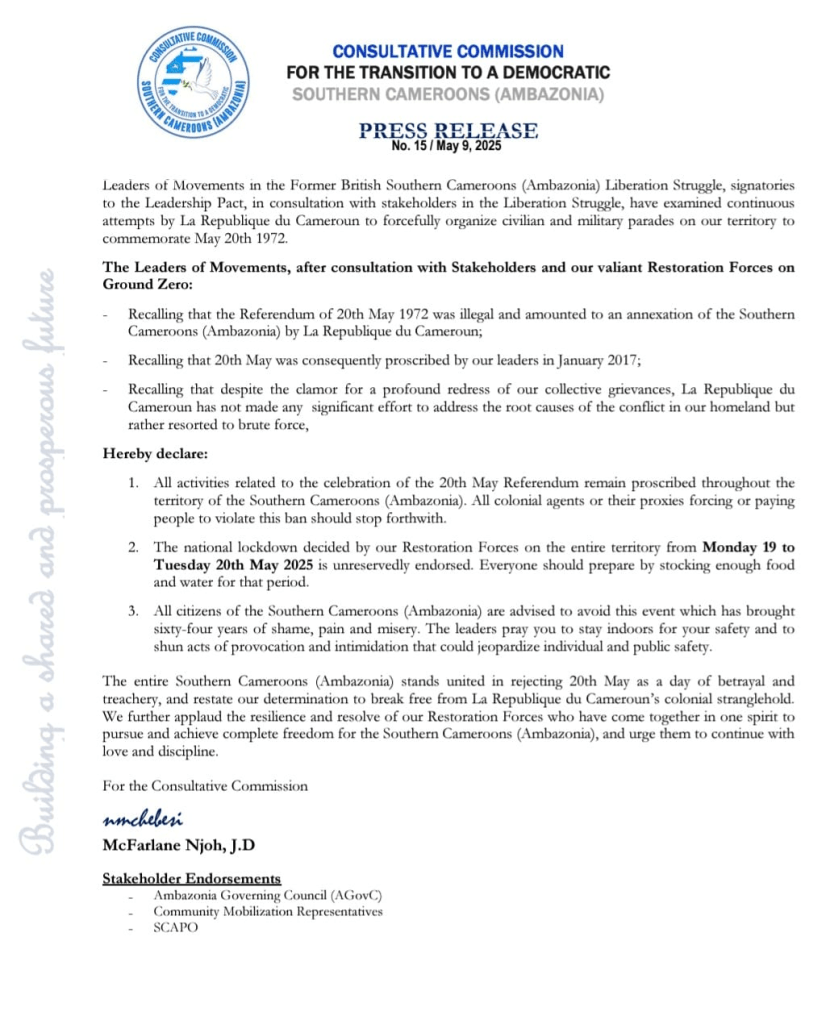
Ambazonian Leadership Pact: Rejecting La Republique’s National Day Charade

FeaturedAmbazonian Flag

The Consultative Commission has issued the Ambazonian Leadership Pact’s ban on this years edition of the La Republique du Cameroun charades on Ambazonian territory.

La Republique du Cameroun, the “former” French colony which “gained independence” on January the 1st 1960 has a habit of marking their national day on May the 20th in typically Camerounese behaviour, which ignores the day they purportedly gained independence and instead highlight’s the day they botched their assimilation attempt on the then West Cameroon.

For recall, West Cameroon was the equal-status state to East Cameroon in the Federal Republic of Cameroon which should have been created after the 1961 plebiscite, which saw British Southern Cameroons vote to “gain independence by joining La Republique du Cameroun”. As it happens, La Republique du Cameroun broke all her international engagements on the process.

First the Federation was not signed off so it never actually existed. Then, it was illegally “modified” in a “referendum” which could not have legally taken place, especially as it did not follow any modification of the “constitution” of the Federal Republic of Cameroon, which itself had not been passed by both of the equal-status federal states, and therefore …

As if these breaches of international law were not, enough, in 1984, La Republique du Cameroun decided to “improve national unity”, further by reverting to their name at independence. Fortunately for Southern Cameroons, then “West Cameroon” and, now, Ambazonia La Republique du Cameroun’s decision to revert to their 1960 name, by the provisions of the Africa Union’s Charter also shrank La Republique’s borders to their state in 1960, thereby releasing Southern Cameroons from any engagements flowing from the 1961 plebiscite and any “understandings” expected from same.

These ideas have been tested variously in court in Banjul and in Bamenda, in particular where the ruling in Ambazonia vs Cameroun, HCB 28/92 was issued in favour of Ambazonia. Elsewhere in Banjul, La Republique du Cameroun’s argument that “Southern Cameroons” was not a people was dismissed by the African Court, who accepted the grievances of the complainant Southern Cameroonians, urging La Republique du Cameroun to address the “legitimate” grievances.

La Republique du Cameroun’s perennial “solution” was to cultivate a class of “elites” from among the people of Ambazonian origin, whose role is to benefit from privileges under the patronage of La Republique du Cameroun’s ruling “elite” – ironically called “les gouvernants” in their common parlance! The Ambazonian-origin “elites” are somehow supposed to benefit from those privileges and patronage on behalf of the rest of the people!

Every year La Republique du Cameroun stages marches to prove the “unity” that they have spent so much time undermining. They will do it again this year and will try to persuade their citizen with tinned fish and bread, to come out and make-believe. As outlined in previous paragraphs, La Republique du Cameroun does not include Ambazonia and Ambazonians have asserted their independence, which they are protecting through self-defense in the face of continued intimidation and “illegal and forceful occupation” by La Republique du Cameroun militias and military. Any Ambazonian who succumbs to bread and fish inducements by either the “eiltes” or directly from La Republique du Cameroun functionaries, does so at their own risk and could be caught in the cross fire of Ambazonian self-defense forces as they resist the La Republique occupation forces.

Ambazonian citizens are urged to continue to show their independence and enjoy their dignity rather than be seen with fish and bread from their oppressors. In Ambazonia’s future all our citizens will be metaphorically taught to fish rather than given fish. Our children shall shine like the stars above and be able to go out into the wider world and fish on an equal footing to all other skilled peoples of the planet.

Consultative Commission promises important milestones for Ambazonia in 2025

Ambazonian Flag

The Consultative Commission lived up to its name and held it first 2025 consultation in a Townhall on Saturday 1st of February.

Among clarifying and dispelling various misconceptions, the CC promised important milestones for the year 2025, the culmination of which would be the All-Ambazonia Conference. Among one of the questions was a keen-eyed contributor’s observation that the acronym was exactly the same AAC as the old AAC of Dr Munzu’s day.

The Commission clarified that the All-Ambazonia Conference is a conference of Ambazonians, by definition, those who implicitly, and more likely, explicitly, believe in Ambazonia’s external self-determination outside of the purview of La République du Cameroun, whereas the AAC of yore was about “anglophones” within the shadow La Republique du Cameroun. Recall that the last contributions from Dr Munzu on the Ambazonia Liberation Struggle was about some forlorn dream of a Federation to be negotiated “within” even though La Republique has been hard at work intimidating their own citizens for merely using the word “federation”. Even if there were a sizeable of “Ambazonians” still hoping for a federation with La République du Cameroun, the irony would be that Ambazonia need not worry about them as La Republique would not countenance any such “solution”.

Among the milestones Ambazonia News can list are Collaboration among Ambazonian Independentists and active upskilling in expertise to be in a better position for when negotiations come at the end of the Liberation Struggle, talking of which, another misconception that the Commission sought to dispel was the idea that the Commission was seeking to unilaterally represent Ambazonia in “imminent negotiations”. The Commission clarified that its work was to upskill, build-ridges between Ambazonians through consultations to ensure that when La Republique reaches the pinch point of a Mutually Harmful Stalemate, Ambazonian side would be “ready”, knowing what and how they wish to get from negotiations. The Commission will not represent Ambazonia without first consulting and getting their consent. In fact the Commission cannot seek to represent Ambazonia as it is not in its Terms of Reference to do any more than its current function of building bridges between, and upskilling with Ambazonian independentist groups.

Away from the Commission per se, other milestones include the Community Mobilization and Ambazonia National Reconciliation, which both show our resilience and growing maturity in first recognizing the need, and then seeking to address it. Ambazonia is here to stay as Ambazonians want it and are in charge of actualizing it.

On Community Mobilization, Ambazonia News would point the organizers toward the key role they can play, should they figure out the mechanics, in achieving the a real milestone in decolonization. Our people on G0 need to start being independent and one of the methods is to promote and implement Community Schools away from and independent of La République du Cameroun’s impositions. Were this to spread, La République du Cameroun would see any remaining vestiges of influence on Ambazonian soil evaporate even quicker than with the expulsion of their “poor-people’s children”

International partners will address Ambazonia directly and independently of La République du Cameroun. This is in the wake of Ambazonia winning the last two encounters in Switzerland and in Canada, by 2-0, where La République du Cameroun’s shambles and “lack of an adult at home” contrasted sharply with Ambazonia’s considered and mature showing at a time when the “international partners” were still inclined towards presenting the Liberation Struggle as a conflict “in Cameroon”.

The Most High God is constantly watching over us and guiding us towards our independence.

The motto is Optimism and Milestones to Reach.

Mr Biya Does it again – Or rather doesn’t again!

FeaturedAmbazonian Flag

On the 5th of November 2024 there was a landslide in Dschang in La Republique du Cameroun’s border province known as La Region de L’Ouest, for being the western-most province of that country bordering onto Ambazonia in the North.

Ambazonia News extends the prayers of neighbouring Ambazonia to the victims, many of whom have, for generations freely come and gone into Ambazonia, intermingling with Ambazonians.

Five days after the disaster, La Republique du Cameroun’s “Prime Minister, Head of Government” posted on X to blame nature and offer prayers and condolences to the victims. He referred to the voice of Mr Biya, whose own social media post is still to come. Mr Biya clearly think his other clever invention – the “presidential silence” is appropriate for this massive loss of life.

There has been no visit by any La Republique du Cameroun minister to assess the situation, probably because there was a similar landslide in the same area in 2021, killing more than 50.

As “Le Cameroun c’est le Cameroun”, Ambazonia News is not questioning what was done to mitigate future occurrences if/when the 2021 episode was assessed.

Even for LRC, it is striking that the “government” has been so mute – even to the lack of the usual communique which would credit Mr Biya with releasing many billion of XFA to console the victims.

While there was nobody at home for the disaster, the government was busy projecting a documentary of Mr Biya’s achievements in his 42 years in office and organising celebrations and orations to mark ascension to the the Presidency. Don’t blame Ambazonia News! That is the language they use in their circles.

There is no shortage of ministers in La Republique du Cameroun but it seems they were all too busy – even JDDM who is meant to be from the neighbourhood of the disaster!

There is a possible explanation. The RDPC, Mr Biya’s “governing” party may well have been pre-occupied with celebrations on the 6th of November, but at least one of them could have commented or shown an interest. None of them did maybe for the callous reason that they did not want to be seen to be taking the lead. Yes that is a bad thing as Mr Biya is ailing and has a habit of culling the tall poppies. It wouldn’t do to project one’s self in the fevered atmosphere of Mr Biya’s imminent departure. So nobody did!

So they celebrate the 42 years of someone who succeeded a much younger person in office – the much younger person having decided to step down when they were a much better “leader” than Mr Biya subsequently proved to be!

The RDPC tabloid “Cameroun Tribune” ran an earnest editorial repeating Mr Biya’s 42 year old “mantra” of New Deal, plagiarized from the US of course, but claimed and celebrated as Mr Biya’s idea. No irony that under the new deal the regime not only could not carry out his other slogan of “Rigour and Moralization”, which were meant to fight nepotism, tribalism, corruption…

It is not an exaggeration to say that Mr Biya institutionalized those vices in his 42 years – to the extent that his regime is now in grid-lock too ashamed to repeat itself when “nature” provides the ill-timed [more like timely] evidence, if it were needed, that “Rigour and Moralisation” have become “Laissez-faire and Immorality” much like the descent of Rome into anarchy on the eve of the fall of the Roman empire. Speaking of Rome, this, if there were any doubts, is the nth crossing of the Rubicon! Even the normally fearful Camerounese are voicing discontent about the silence and disdain regarding this latest Dschang Disaster.

it is time for Mr Biya to formally bow out. It is no secret that he has not been “in” for at least a decade!

As Ambazonia News has postulated in the past, there is no one at home in La Republique du Cameroun!

Ambazonia needs to go ahead with running our country. It was never a protest or plea to gain special status of devolution or federation or any other supplicant status in a country which is so inept and unable to manage its own affairs.