

A POST-WAR VISION FOR THE NEW SOUTHERN CAMEROONS CONFERENCE

FeaturedAmbazonian Flag

A POST-WAR VISION FOR THE NEW SOUTHERN CAMEROONS CONFERENCE:

Organizational Red Flags, Infiltration Risks and Institutional Safeguards.

_Fontem Neba, PhD

_Scholar, Critic & Political and Civil Rights Advocate_

Abstract

This paper examines the risks that could weaken a future All Southern Cameroons Conference and suggests ways to protect its independence and credibility. Drawing lessons from AAC I, AAC II and other liberation conferences, it identifies ten warning signs, including unclear representation, personal control, hidden funding, unauthorized talks and poor record-keeping. It also discusses possible signs of government infiltration while stressing that suspicion is not proof. The paper recommends clear rules for delegate selection, financial accountability, information security, leadership oversight and conflict resolution. These safeguards can help build trust, unity and strong institutions for Southern Cameroons’ post-war political and developmental future.

*________________________________*

 Introduction

 We have earlier said that a new All Southern Cameroons Conference, if convened, should be understood as more than another political gathering. It will provide an important opportunity for Southern Cameroonians to develop a cohesive political, organizational and developmental framework for the post-war era. After years of conflict, communities will need to learn, or relearn, how to coordinate their interests, work together, establish rules for collective action, identify the consequences of the war, and develop immediate, medium- and long-term responses to political, economic, social and humanitarian challenges. The Conference could also provide a legitimate mechanism for determining how Southern Cameroonians engage with the Government of Cameroon and other external actors.

 We have also previously noted that the experience of AAC I and AAC II demonstrates both the possibilities and vulnerabilities of territory-wide political organization. AAC I brought representatives from the thirteen divisions together in Buea in 1993, while AAC II followed in Bamenda in 1994. Contemporary historical records document both the breadth of representation and the difficulties surrounding the conferences and their relationship with government. The lesson for a future Conference is therefore not merely that Southern Cameroonians can unite, but that *unity must be protected by institutions, procedures and accountability.*

 However, the Conference must also recognize that uncertainty, fragmentation and competing claims to representation can weaken collective political organization. Some Southern Cameroonians believe that previous initiatives were obstructed, divided or subjected to government influence. Such claims should be approached with circumspection. The appropriate response is therefore not suspicion of every participant, but the construction of institutions in which manipulation becomes difficult and allegations can be independently verified.

 This is especially important because the presence of Southern Cameroonians in government does not, by itself, demonstrate that the underlying political, economic and developmental aspirations of the population have been achieved. We must not confuse appointments and administrative positions with broad improvements in roads, employment, industries, hospitals, housing, education, infrastructure and living standards. A future Conference should therefore concentrate on collective institutional capacity rather than individual access to government.

 The Conference Must Protect Its Own Institutional Integrity

 The greatest danger may not be an obvious attempt to destroy the Conference. It may be a series of seemingly minor organizational weaknesses that gradually produce confusion, mistrust, factionalism and loss of institutional authority. Historical accounts of AAC I show that organizers faced difficulties securing an appropriate venue, while AAC II was convened partly to assess the consequences of the suspension of the constitutional reform process and the performance of the Standing Committee.  These experiences underline the importance of designing institutional safeguards before political pressure arises.

The following ten organizational red flags should therefore be treated as matters requiring attention. None is, by itself, proof of government infiltration. Their importance lies in the pattern they may reveal and in the institutional weaknesses they expose.

 1. Unclear or Manipulated Representation

 The first major red flag is uncertainty about who actually represents a division or constituency. If delegates are selected privately by a small group, if established procedures are repeatedly changed, or if prominent individuals are allowed to appoint themselves as representatives, the Conference becomes vulnerable to capture.

 Representation should originate from clearly identified constituencies. There should be transparent procedures for selecting delegates, documenting their mandates and replacing them when necessary. The question should always be: *Who does this person represent, who selected them, and what authority have they been given?*

2. Excessive Personality Politics

 A second red flag appears when the Conference begins revolving around personalities rather than institutions. If one individual becomes indispensable, controls information, dominates meetings, appoints committees, *speaks externally without authorization* or presents personal views as Conference positions, institutional independence is already weakening.

 Leadership should therefore be temporary, accountable and replaceable. No individual should possess authority simply because of age, wealth, political history, government experience or international connections. *The Conference should be stronger than its leaders.*

3. Sudden Attempts to Change the Agenda

 Another warning sign is the unexplained alteration of the Conference’s agreed agenda shortly before or during major deliberations. A Conference established through broad consultations should not suddenly abandon the issues that communities mandated delegates to discuss.

 Agenda changes should require transparent procedures and recorded justification. Emergency matters may arise, but they should not become a mechanism for a small group to introduce predetermined political outcomes without adequate consultation.

 4. Pressure to Avoid Documentation

 Institutions become vulnerable when important decisions are deliberately kept off the record. A demand that meetings should not produce minutes, mandates, voting records, financial reports or written agreements should be treated seriously.

 Transparency does not mean exposing sensitive personal information. It means maintaining sufficient institutional records to establish what was decided, by whom, under what authority and through what procedure. Without documentation, competing individuals can later claim that the Conference authorized almost anything.

 5. Unexplained Financial Dependence

 Financial vulnerability is another significant red flag. A Conference dependent upon one wealthy individual, one political organization, one foreign sponsor or an undisclosed source of funding may eventually find its independence compromised.

 The institution should establish transparent financial rules from the beginning. Contributions should be recorded, significant donors disclosed where appropriate, expenditures audited and conflicts of interest declared. Financial support should never automatically confer political authority.

6. Private Negotiations on Behalf of the Conference

 A particularly serious organizational weakness occurs when individuals begin negotiating with government or other external actors without a clearly defined mandate.

 Dialogue with government is not inherently problematic. Indeed, a credible political institution should have the capacity for peaceful engagement. The danger arises when private conversations are presented afterwards as agreements of the Conference or as commitments binding its constituencies.

 All external negotiations should therefore be conducted by authorized representatives under written mandates, with reporting requirements and procedures for accepting or rejecting proposals.

7. Deliberate Division Along Regional or Social Lines

 Another red flag is the systematic attempt to turn legitimate differences between divisions, communities, generations or social groups into permanent political hostility.

 The thirteen-division framework is valuable precisely because it can provide a structure in which different communities retain their identities while participating in one institution. AAC I itself was documented as representing all thirteen divisions, making territorial representation an established historical reference point. 

 Disagreement should therefore be expected and legitimate. What should be resisted institutionally is the transformation of disagreement into permanent exclusion, intimidation or competing claims that some Divisions are dominant. However, we must avoid accepting tasks we don’t understand or cannot execute just because we want to create a balance. Southern Cameroonians must learn to turn down requests they cannot handle.

8. Sudden Delegation Expansion Without Verification

 A further red flag is unexplained growth in the number of delegates, observers or organizational representatives without corresponding verification procedures.

 Large participation can strengthen legitimacy, but unverified participation can create confusion about voting rights and institutional authority. *The Conference should distinguish delegates, observers, advisers, technical experts and invited guests.* Each category should have clearly defined rights.

9. Attempts to Weaken the Preparatory Commission or Secretariat

 If a Preparatory Commission is created to establish procedures, its independence must be protected. Attempts by individuals or organizations to bypass the Commission, alter its membership without due process or prevent it from publishing accreditation rules should receive careful scrutiny.

 The same principle applies to the Permanent Secretariat. Administrative personnel should maintain institutional records and procedures irrespective of which political faction controls the leadership at a particular moment.

10. Pressure for Immediate Decisions Without Adequate Consultation

 The final red flag is pressure to make major irreversible decisions before delegates have had sufficient opportunity to consult their constituencies.

 Urgency can be legitimate during political crises, but urgency can also be exploited to prevent careful deliberation. Major decisions should have defined thresholds, written proposals, opportunities for amendment and clear voting procedures. The Conference should never confuse speed with legitimacy.

SIGNS THAT MAY INDICATE POSSIBLE GOVERNMENT INFILTRATION

 Government infiltration is a serious allegation and should never be inferred merely from someone’s political position, geographic origin, government employment, disagreement with the majority, or participation in dialogue. A Southern Cameroonian who works in government is not automatically an agent of government influence. Likewise, disagreement with Conference policy is not evidence of infiltration.

 The following are therefore *indicators requiring verification*, rather than proof of infiltration.

1. Repeated Attempts to Obtain Unauthorized Access

 If an individual repeatedly seeks access to confidential preparatory documents, delegate lists, internal correspondence or sensitive deliberations without a legitimate institutional role, the matter should be investigated through ordinary access-control procedures.

 The appropriate response is not accusation. Access should be limited according to role, sensitive material should be distributed on a need-to-know basis, and unusual requests should be documented and reviewed.

2. Persistent Efforts to Identify or Expose Participants

 Another concern would be systematic attempts to obtain information that could expose participants to unnecessary political, legal or personal risks. Such activity should be distinguished from legitimate administrative registration.

 The Conference should collect only information genuinely necessary for accreditation and administration, protect personal data, and establish clear rules governing who may access participant information.

3. Attempts to Manufacture Internal Distrust

 A possible warning sign is a recurring pattern of unverified allegations designed to turn delegates against one another. This might include claims that particular divisions have secretly reached agreements, that certain leaders have betrayed the Conference, or that particular groups are preparing to abandon the institution, without credible evidence.

 The proper response should be verification rather than retaliation. An independent ethics or dispute-resolution mechanism should examine serious allegations before they become political weapons.

4. Pressure to Abandon Institutional Safeguards

 Particular attention should be given to attempts to persuade the Conference to remove transparent accreditation, financial controls, voting procedures, conflict-of-interest rules or reporting requirements.

 Such safeguards protect everyone, including participants who may be wrongly suspected. Their removal would make genuine infiltration and ordinary political manipulation harder to distinguish.

5. Unexplained Relationships Between Internal Decisions and External Government Actions

 A pattern in which confidential internal discussions are repeatedly followed by government actions that appear unusually well informed may warrant an institutional security review.

 However, correlation is not proof. Information can leak through many ordinary channels. The correct response is to examine document access, communication procedures and information-handling practices rather than immediately identifying a supposed culprit.

6. Attempts to Create a Parallel Chain of Authority

 A further warning sign would be the emergence of an unofficial structure claiming to give instructions to delegates independently of the Conference’s constitutionally established leadership.

 The Conference should make its decision-making hierarchy explicit from the beginning. No individual, government office, political party, traditional authority, diaspora organization or external institution should be able to issue binding instructions to delegates unless the Conference’s rules expressly provide for such authority.

7. Persistent Efforts to Provoke Premature Collapse

 If particular actors consistently push the Conference toward walkouts, expulsions, procedural breakdowns or irreversible confrontation whenever disagreement arises, the pattern should be examined objectively.

 Again, disagreement itself is not evidence of infiltration. A healthy institution will contain genuine critics. The relevant question is whether a recurring pattern of conduct is undermining established procedures without a legitimate institutional purpose.

How the Conference Should Respond

 The best response to infiltration risk is not paranoia. It is *institutional resilience*. A strong institution makes infiltration less consequential because no individual possesses enough unchecked authority to capture the organization.

a) The Conference should establish an independent Ethics, Compliance and Institutional Integrity Committee. Its members should have clearly defined terms, conflict-of-interest rules and authority to investigate credible complaints. It should report to the Conference rather than to individual leaders.

b) The Conference should establish a documented accreditation system. Delegates should be verified against mandates issued by their constituencies, while observers and advisers should be clearly distinguished from voting delegates.

c) Sensitive information should be protected through ordinary organizational security practices. Access should be based on institutional role, important records should be preserved, and confidential information should not be circulated unnecessarily.

d) Allegations should be handled through evidence and due process. A person should not be expelled, publicly denounced or deprived of participation merely because another delegate suspects them of being an agent. False accusations can destroy trust just as effectively as genuine infiltration.

e) Financial independence should be treated as political independence. The Conference should maintain audited accounts, publish appropriate financial reports and prevent undisclosed financial relationships from influencing institutional decisions.

f) External engagement should be centralized through a transparent mandate. Government dialogue, international engagement and communication with political organizations should be conducted by designated representatives whose authority is documented and whose actions are reported back to the institution.

g) The Conference should establish succession mechanisms before the first major crisis occurs. If a leader resigns, accepts government office, becomes unavailable or loses the confidence of the institution, another properly authorized person should be able to assume the role without destabilizing the entire organization.

h) The Conference should institutionalize disagreement. Delegates should be able to challenge decisions without being branded enemies of the people. Minority reports, recorded dissent, appeals and reconsideration procedures can prevent political disagreement from becoming organizational warfare.

Preparing for the Post-War Era

 The deeper purpose of these safeguards is not simply to protect a conference from government interference. It is to prepare Southern Cameroonians for the responsibilities of political and institutional life after war.

 The war has created enormous challenges that cannot be solved through political declarations alone. Communities will need to consider reconstruction, displaced populations, destroyed infrastructure, education, health services, employment, agriculture, industry, housing, local government, security, reconciliation, public finance and the restoration of social trust.

 These problems require planning across divisions and generations. They also require mechanisms for negotiating with government and other actors while maintaining a clear mandate from the people represented.

 A Conference that cannot maintain its own records, manage disagreement, protect finances, verify representation and survive leadership changes will struggle to manage the far more complex responsibilities of reconstruction and political transition.

 The Conference should therefore be viewed as a school of institutional democracy. Its procedures should demonstrate the kind of political culture it hopes to create: accountability instead of personality worship, evidence instead of rumor, representation instead of self-appointment, consultation instead of unilateralism, and peaceful disagreement instead of fragmentation.

Conclusion

 A new Southern Cameroons Conference could become an important instrument for political coordination, post-war planning and institutional renewal, but its success will depend less upon the prominence of those who attend than upon the quality of the institutions they establish. The historical experience of AAC I and AAC II shows the importance of representation, mandate and continuity, while the broader comparative experience of liberation conferences demonstrates that unity must be organized rather than merely proclaimed.

 The key lesson here is therefore vigilance without paranoia. Organizational red flags should be identified early, possible infiltration should be investigated through evidence and due process, and institutional safeguards should make individual manipulation difficult. No person should be above the rules, but no person should be condemned without evidence. If Southern Cameroonians can build a Conference capable of surviving disagreement, leadership changes, external pressure and political uncertainty, they will have begun constructing something more valuable than a single gathering: an enduring institution capable of coordinating their collective political and developmental future.
Ambazonian Education – the question of decolonisation. “Look West!”

Ambazonian Flag

DESC, the Interim Government’s Department for Education Strategic Collaboration has put forward some answers to questions about the future of Ambazonian Education. The summary is that Ambazonia will “look West” for the immediate term to solve the most pressing issue of La République du Cameroun’s continued interference with our children’s futures.

First the questions. Where is the Ambazonian Curriculum? How are our children going to be assessed and certified so that they can progress in life? How can we help? These are some of the key questions which have been tabled in APP meetings hosted by the IG to open itself to accountability in line with its “Action and Accountability”, AA, doctrine. For memory, AA, along with Building Bridges, BB, and Complementary Commitment, CC, are the pillars on which the IG manages her prosecution of the Ambazonian Liberation Struggle.

Back to DESC on Education and the way forward for Ambazonian Institutions. DESC is encouraged by the proliferation of Community Schools in Ambazonia as they show the people’s vote against La République du Cameroun’s meddling. Until now,  the big question has been the issue of examination and certification with the incongruous situation that Ambazonian Community schools have had to informally seek certification from La République du Cameroun’s appointed boards. DESC expects that the long term terminal goal for Ambazonia is to establish independent and competitive Ambazonian Exam boards to run assessment and certification for secondary education, allowing Ambazonian students to gain access to higher education institutions and universities worldwide. In the short term the most viable solution will be to seek certification, initially as external candidates, from WAEC, the West African Examination Council, and eventually, medium term, to establish Ambazonian membership of WAEC so that WAEC can run local affiliated centres.

Before further questions, Ambazonia does not need to be “recognised” to exercise the right to education and self-governance – look at Somaliland. The step away from La République du Cameroun in this domain is the next and probably most psychologically difficult but is the logical break that will see La République influence even through their fifth columnists, who like to be described as “elites”, dwindle. On this step DESC is appealing to all Ambazonian Independentist movements to collaborate by supporting all the community schools they support to make this break. At the very least they should align their charges towards this separate route from La République du Cameroun.

At primary level, our community schools can expect further orders once DESC has compiled information on the options for assessment.

On the question “how can we help?” all Ambazonians and friends of Ambazonia can contribute their expertise, knowledge and experience to help our children, learn and develop their minds in line with all other children in every other nation on our planet. If you are a specialist in E-learning, or know how to deliver such material Ambazonia needs you. If you know an organisation which is willing to donate such materials to our schools on G0 or in refugee camps in G1, Ambazonia needs you. Think that books are the past? No. Ambazonian children need them on G0 and G1. Our children need to know that we are thinking of them. Nothing is insignificant.

The Most High God is the Watchman of Ambazonia.

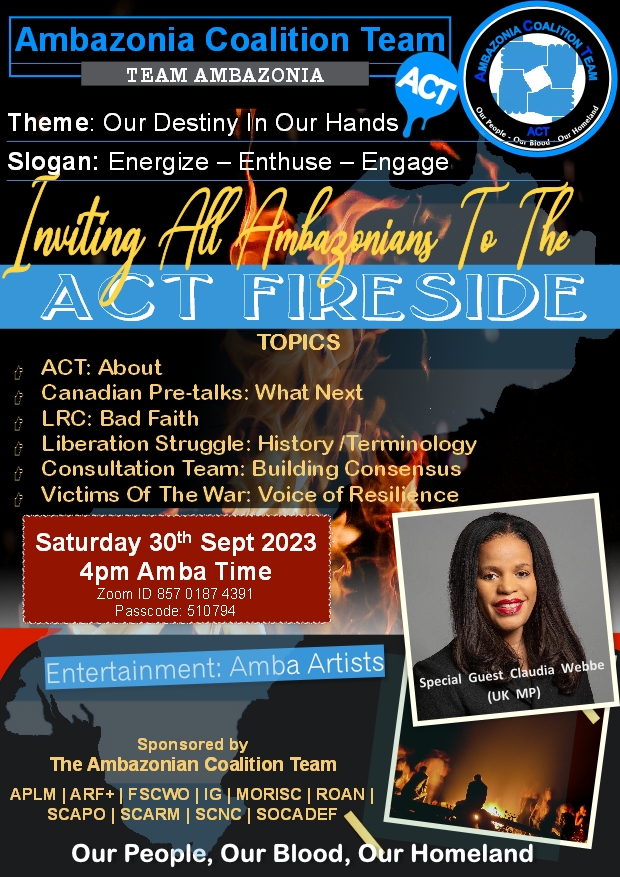
ACT -Team Ambazonia in fireside chat on eve of Independence day 2023

ACT, the Ambazonian Coalition Team, is holding a fireside chat this Saturday 30th September 2023 from 4pm Ambazonia time.

We the Ambazonians and friends and well wishers of Ambazonia are all warmly welcome to come and share.

Learn about ACT and how to contribute.

Be entertained by our artists.

Finally meet one of the British MPs who has been in our corner in this Ambazonian Liberation Struggle.

Our destiny is in our hands.

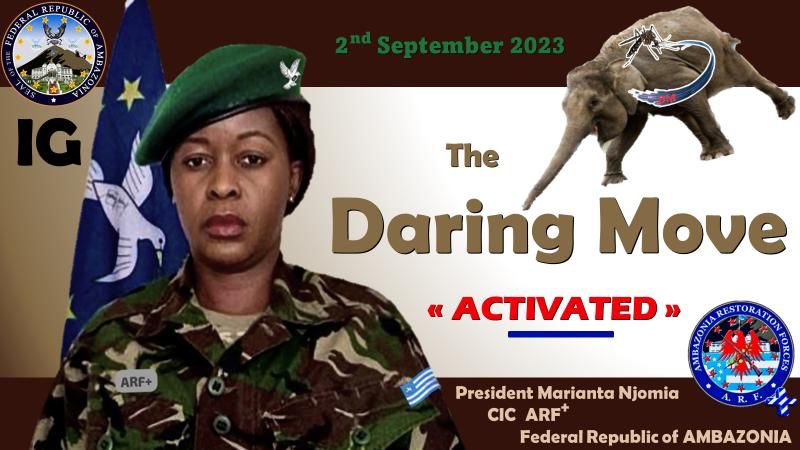
Daring Move indications.

Since IG President Marianta Njomia signaled the Daring Move there has been noticeable daring on G0.

It is clear that we The Ambazonians must prove our readiness and ability to fund, fight and free and the Daring Move is the long term method to achieve our objectives.

As specified in the Executive Order which rechristened and renamed the ARF to ARF+ our liberation and self defense forces have better defined methods including ownership of their safety and local decisions in the immediate within the wider objectives of Daring Move: to target the economic interests and comfort of all La Republique du Cameroun allies and agents in Ambazonian territory. The fifth columnists are an urgent target though ARF+ stills own the immediate local target priority on the basis of their safety.

The IG maintains our appeal to international partners to come to the help of our civilian, notably children whose development is being impeded by the forceful and illegal occupation under which La Republique du Cameroun is imposing a deliberately substandard education on Ambazonian children. We endorse Community schools which will use and develop our own Ambazonian curriculum. The support we need from the international community is to enable safe zones around our Community schools.

The international community must not neglect the refugees currently enduring untold misery in neighbouring countries.

The Most High God remains the Watchman of our Nation and guide to the ARF+.

Herbert Boh on “The Canada Process”

The World Versus Southern Cameroons

By Ntumfoyn Boh Herbert (Yindo Toh)


Another leg of a century-old game – the World versus Southern Cameroons – will be played next week in Canada. The players, referee, line judges, spectators, match delegates, fans, financiers, and victims (over 30,000 slain since November 2017) are the same. 
 
Bloody rounds of the tragic version of this game are being played in Southern Cameroons, to the deafening silence of the international community – unimpressed by genocide. Worse than criminal silence, those who, not so long ago, called for “negotiations without preconditions”, are back to pulling strings, in the shadows and watching the game… in callous indifference. The game prioritizes interests over rights or lives. In it, geopolitics trumps sovereignty rights and sticking with allies, however evil the alliance, is better so long as might makes right.
 
Activists for an independent Southern Cameroons have been played at this game for over 100 years. It is the vengeance they got served for rejecting a 44-year-old experiment by the United Kingdom to assimilate them into Nigerians. In 1961, the world ganged up to impose more of the same. In a plebiscite supervised by the United Nations (no less!), Southern Cameroonians were forced to choose either what they had earlier rejected – union with Nigeria – or its next worse alternative – union with Cameroun.
 
Today’s events in Ukraine makes the hypocrisy shouting. Imagine the United Nations and NATO forcing Ukraine (once a part of the defunct Soviet Union) to gain and/or maintain independence either by becoming a part of Russia or by becoming a part of (wild guess) China. Imagine an African country doing what Canada is doing next week: host and moderate an event to tell citizens of Quebec to give up their campaign, not to obtain, but to restore their independence. Imagine South Africa staging a public relations event on behalf of the rest of Canada while the latter’s army slaughters citizens of Quebec. The West is willing to go nuclear in defense of Ukraine, but engages in diplomatic hide-and-seek games if required to decry genocide. It won’t set aside its interests to reaffirm the rights of natives to self-determination, self-rule, and freedom from colonial domination in all its forms. You heard right: “black lives (don’t) matter”. 
 
That’s how genocide is made. Impunity. The kind of impunity that France and Cameroun enjoy in Southern Cameroons under the pretext of fighting “terrorists” and “secessionists”. The insistence to keep Southern Cameroons a part of Cameroun that Nigeria did not have in 1953-54 when Ambazonia broke away and that Russia can’t evoke in dealing with ex-Soviet Ukraine. 
 
Cameroun’s tyrant-for-life, Paul Biya, has confessed that this is about treating other humans as game. “We tried assimilating their system into the majority francophone system but because of identity difference, it failed,” Biya told Sudanese-born telecoms billionaire Mo Ibrahim during an interview in 2019. Cameroun’s failed 61-year-old experiment, like the 44 years of efforts by Nigeria, will never convert Ambazonians into Camerounians. The resolve of this “Never Again Generation” will never be broken. In fact, the monkey games which give Cameroun a pass for engaging but not committing to the Swiss Process or play prolongation time in Canada, pretending to be for mediation, will only persuade movements like mine, MoRISC, to get fully involved with funding self-defense or start an armed wing… because monkey see, monkey do.
 
Today’s unraveling was both predictable and predicted. Dag Hammarskjold, the UN Secretary General from 1953-1961, warned that “uniting the Southern Cameroons to the Cameroun Republic is like forcing a balloon under the sea. One day, it will come out”. That day broke fast… dawning before Dag Hammarskjold’s tragic loss in a plane crash. In the hope of drowning the Ambazonian independence balloon, the West ignored the overwhelming vote for independence at the Mamfe Conference in 1957. It violated the UN Charter. It looked away in February 1961 as Cameroun (independent on 1st January 1960) adopted a federal constitution under which it effectively annexed Southern Cameroons. This was two months before the 21st April 1961 UN vote for independence and five months before effective independence on 1st October 1961.
 
France, a veto power-wielding Permanent Member of the Security Council sold all shame to defend its interests, delaying UN resolutions and causing the vote to be taken several times in the forlorn hope that Southern Cameroons would be denied independence. That campaign failed, but the game was only getting started. Since 1961, it’s been played into prolongations. The United Kingdom has swallowed its tongue, seeing no evil, hearing no evil, and saying no evil of its ally, France. London has watched with sealed lips as Paris has led Southern Cameroons, like a sheep from self-government (even under colonial rule back in 1954) to the slaughter house of recolonization. Along with UN officials, the UK declared forfeiture, staying away from the UN-mandated Foumban Conference in July 1961 where France and Cameroun were allowed to snatch victory from the jaws of the bitter defeat they suffered three months earlier at the UN General Assembly.
 
This history is useful in understanding why the West, to this day, plays spectator. Three years ago, when the Swiss Government announced that it had the consent of Cameroun and Southern Cameroons liberation movements to launch a mediation process for “negotiations without preconditions”, the same old games were reactivated. In public, the West blessed the initiative. In the dark, the world – the UN, the African Union, the European Commission, the Commonwealth of Nations, the governments of the United States, the UK and Canada – did little for it to work. Supporting the Swiss in what was the first meaningful opportunity since the Foumban Conference to address the root causes of The Southern Cameroons Problem would have hurt the interests of colonizers – akin to scoring an own diplo-goal. 
 
So, the West pretended to pressure Cameroun. It said all the right things, by day. By night, though, world powers sabotaged the process. After three years of mumbling support for the Swiss-led Process, France has confessed it is as “blind” as it claimed to be during the Rwanda Genocide. Last July, Macron sang from the same hymn book as his “best pupil”, Paul Biya, when he called for a return to the well-documented failed solution known as decentralization. In the shadows, Canada, a major financier of the Swiss Initiative, had already embarked on collaborating with so-called moderates in the Biya regime (if they exist).
 
Next week, Canada will deliver for Yaounde when it hosts and moderates Cameroun’s Second Grand National Dialogue in Canada. In Canada’s minority French-speaking Quebec Province, where an army of mostly Canada’s majority English-speaking people is not slaughtering those who seek independence for Quebec; in the province which France actively supported to secede from Canada, Ottawa will host what Cameroun dreams could be the first step in Ambazonia’s surrender. Ottawa is open about a few secrets. For the record, it admits this is not Canada initiating another third-party mediation. Please, read: this is Canada playing monkey games at the behest of powerless, spineless “moderates” in the Biya regime. They are at the service of Slave Prime Minister Dion Ngute who claims to have the blessings of Tyrant Biya for this N-th dead-on-arrival effort at reversing the irreversible.
 
As both umpire and player in Canada – a sharp contrast with its status of “one of two, both equal in status” under the Swiss-led Process – Yaounde cannot wait for kick-off. It has already dispatched three junior level French-speaking staff from Dion Ngute’s office. Nine enablers of Southern Cameroonian descent, most of them civil society representatives based in Southern Cameroons, and two regime apparatchiks (an unelected mayor and the head of the so-called National Youth Council) complete their line-up. These characters will face off against individuals and leaders of organizations supposedly fighting for independence. They are swimming against an irreversible tide. A tsunami of Ambazonians, in their millions, see through these games and, like me, will never attend. Sadly, for a fortnight, I have been horrified to witness people I have considered comrades in the struggle literally beg to be invited to this Camerouno-Camerounian Grand National Dialogue hosted in Canada.
 
Canada’s role – even as moderator – is less than holy. Ottawa is still one of Yaounde’s arms suppliers – genocide notwithstanding. It believes it needs to babysit Ambazonia, helping hand-pick the enablers who will window-dress as Southern Cameroonians next week. Why stop, right? In supporting the Swiss Process, Canada still funded a certain Coalition for Dialogue and Negotiations – opposed to the Process – reportedly to help coordinate self-defense groups. 
 
Getting next week’s rushed game on the fixtures is no accident. That it comes hard on the heels of the Swiss announcement is intended, not unfortunate. Cameroun badly needs a public relations coup. Even the staunchest of Cameroun supporters were caught off guard by its foot-in-the-mouth decision about no longer being interested in third-party mediation. Beginning next week, Canada’s not-so-good offices can help sanitize Cameroun’s blood-dripping hands. It is an off ramp Yaounde needs to blur the message that its military option is full throttle. The West, which in the 1950s feared that an independent Southern Cameroons would be pro-Moscow, now seeks to placate Yaounde to prevent Russia expanding its influence in Africa. 
 

Next week, Cameroun will begin its abuse of Canada. It is just a matter of time before what it just did to Switzerland is done to Canada. Ottawa seems aware. It admits next week will start small and slow. Why go fast with only tens of thousands of Southern Cameroonians – not Ukrainians and not Quebecois – slaughtered, right? To protect its interests, Canada is throwing a life vest to Cameroun, serving as a Trojan Horse. Next week, the Swiss of Humanitarian Dialogue and UN observers will climb out of the belly of the Ottawa Horse and unadvised spectators at this new/old tragicomedy will be fooled into thinking the Swiss endorse this. To their credit, Canada admits that this effort amounts to throwing as much jelly on the wall to see what will stick. It is, they say, bringing together Southern Cameroonians to sought it out among themselves – in Canada. The late Christian Cardinal Tumi has to be turning in his grave.

Community Education starts as La Republique demonstrates impotence

Ambazonian Flag

Reports relayed by mimimefoinfos.com from Bui state that La Republique du Cameroun militias invaded a Catholic school in a criminal intimidation. According to the reports they fired shots and threatened children, insisting “If you like education so much you must go to the government school”, in reference to the La Republique du Cameroun’s sub-standard “schools”. It would appear that La Republique du Cameroun has gone from posing as a dubious protector of the right to education to openly demonstrating that their aim is to “show” that they are running Ambazonia!

The IG this week released the first drafts of the new Ambazonia Interim Curriculum for Community and Authorized Schools. In a statement accompanying the release the IG warned parents and leaders of community schools to brace for just the type of intimidation that is reported. According to sources the IG does not expect this to be sustainable for La Republique du Cameroun as the Ambazonian RFs will collaborate to repel such war crimes. The IG will be seeking the support of peace loving international partners to ensure our children can access education, which is the minimum right if any child on the planet, without having to face such callous actions.

We encourage our people to be mindful that this action, though painful and intimidating only points to our victory as it shows La Republique has finally given up all pretence that Ambazonia was in a union with them and now wish to engage us in an overt manner in front of the international community. It should be recalled that this is a routine modus operandi of La Republique du Cameroun to intimidate school children in their genocidal war against Ambazonia.

They have already previously admitted killing two children on their way to school in the last couple of years when they claimed it was a “bavure” or “mistake”. In any normal country “security forces” would not be firing into school-run traffic, never mind repeating the process a few months later.

Ambazonia News understands the IG will be asking our civilians to stay calm and vigilant but continue to exercise their live-freedom, live-dignity as is their right under international law.

We never signed up to a union and have the right to our own country and educational system separate from La Republique du Cameroun. Even if we had signed up we would still be in the right to seek self-determination from the oppression of La Republique du Cameroun.

“Our children shall be like the stars above.”

“We shall live in plenty meeting our own needs”

“The Most High God is the Watchman of our nation and people.”

Ambazonia News Exclusive: The First Drafts of The Interim Curriculum Available for Community and Authorised Schools

Ambazonian Flag

Ambazonia news is able to post the first drafts of the IG’s Ambazonia Curriculum for Community and Authorised schools in the Federation. Initially the orders are issued for Mathematics, Science and English language for primary schools. More subjects and stages will follow in the future.

This will allow our citizens to consolidate their dignity in taking charge of the future social, professional and personal development of their children. It has always been the ambition of every Ambazonian parent to see their children progress, so much so that they will do anything to ensure they are able to pay the fees to ensure their pride and joy can attend school.

The IG shares this vision and is seeking the collaboration of parents and RFs to jointly make this next leap in the Liberation Struggle. The IG will continue to improve the curriculum orders on the basis of feedback from GZ and the local experience. As promised in a previous post, the IG will work in the meantime to facilitate assessment and certification processes in the future.

May our children soar like the stars above

In honour of the heroes who continue to bear our land with their blood

The Most HIgh God Is The Watchman of Our Nation

Look at the Mathematics orders here

Look at the English Language orders here

Look at the Science orders here

President summons your philanthropist to support Ambazonian refugee children

Ambazonian Flag

1st October 💙Southern Cameroons Independence Day🤍 . This year President Marianta is summoning the philanthropist in us on behalf of the Ambazonian children in refugee camps. We can support their education and welfare at the crucial stage where other children around the globe can take their educational development for granted.

10km Sponsored Charity Walk.

What can you do for the children in the refugee camps?

Support Friends of Southern Cameroons’ effort in providing for our refugee children by making a contribution on PayPal. You will not be charged for the transaction on this link.

Community Schools in Ambazonia: a growing reality, LRC confirms

In a helpful progress check for the citizens of Ambazonia, a LRC functionary has “banned” several Community Schools.

This ban is going to be as effective as the ban on scbc TV a few years ago. Actually much less so. Whatever effect it has in the short term, the long list demonstrates the increasing confidence of Ambazonians to take their dignity in hand and control their own future. In the long term the Ambazonians have decided they need to provide the opportunities their children need to unleash their creativity and join modern society.

Ambazonians can be reassured that their education system will give their children more valuable qualifications than they would get under the LRC colonial system where qualifications do not lead to any kind of social advancement. LRC’s system is riddled with nepotism and corruption so that those who get the jobs sometimes do not need to have gained any qualifications, or sometimes even have studied at all.

Congratulations to the Ambazonians for making the break. An interim curriculum is understood to be in the works and likely to be available in the near future.

Collaboration will consolidate our dignity and freedom.

Our children will shine like the stars above as the most High God is the Watchman of our nation.